
Living in a World That Never Powers Down
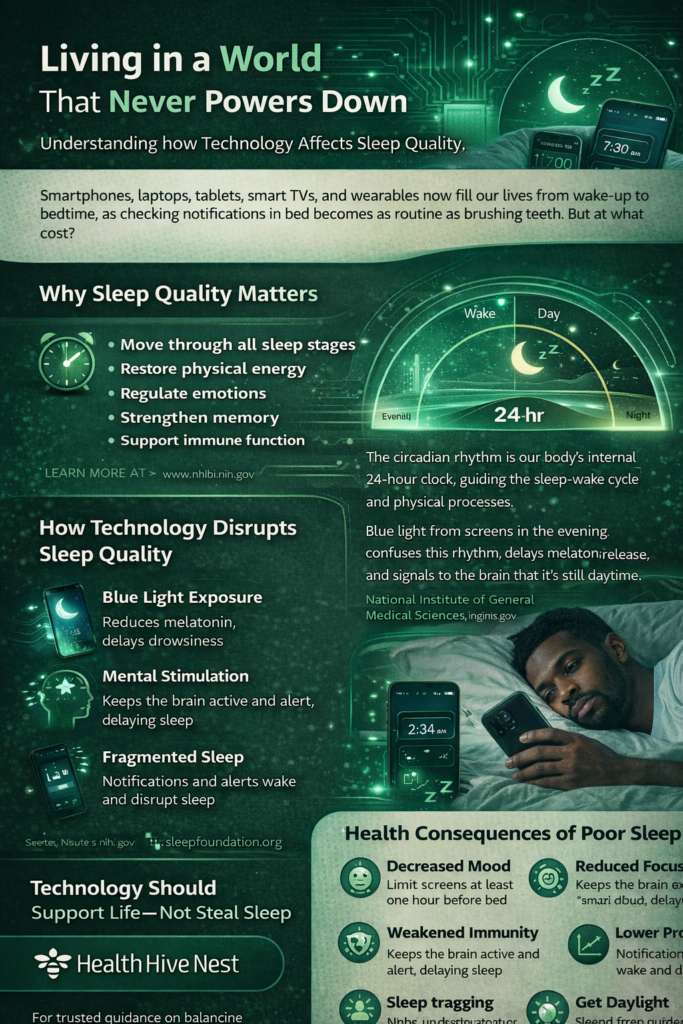
Understanding how technology affects sleep quality has never been more important. Smartphones, laptops, tablets, smart TVs, and wearable devices have become constant companions—from the moment we wake up to the last few minutes before sleep. For many people, checking notifications in bed feels as routine as brushing their teeth.
Technology has transformed how we work, connect, learn, and relax. Yet this constant connectivity comes with an often-overlooked cost: disrupted sleep. Many people struggle to fall asleep, stay asleep, or wake up feeling refreshed, without realizing that their daily tech habits may be playing a major role.
Sleep problems linked to technology do not usually appear overnight. They develop gradually, quietly altering the body’s natural rhythms. Over time, poor sleep affects mood, concentration, immune health, productivity, and mental well-being.
This article explores how technology affects sleep quality, what science says about screens and sleep, and how to create healthier digital habits that support better rest—without requiring you to completely unplug from modern life.
Why Sleep Quality Matters More Than Sleep Quantity
Many people focus on how many hours they sleep, but quality matters just as much.
Quality sleep allows the body to:
- Move through all sleep stages
- Restore physical energy
- Regulate emotions
- Strengthen memory
- Support immune function
According to the National Institutes of Health (NIH), fragmented or shallow sleep can be just as harmful as too little sleep.
https://www.nhlbi.nih.gov
Technology often interferes with sleep quality even when total sleep time appears adequate.
The Science of Sleep and the Circadian Rhythm
The body follows a natural 24-hour internal clock known as the circadian rhythm. This rhythm regulates sleep, wakefulness, hormone release, body temperature, and metabolism.
Light exposure is the strongest signal controlling this clock.
The National Institute of General Medical Sciences explains that artificial light at night can confuse the brain into thinking it is still daytime.
https://www.nigms.nih.gov
Technology devices emit light that directly interferes with this process.
Blue Light and Its Effect on Sleep
What Is Blue Light?
Blue light is a short-wavelength light emitted by:
- Smartphones
- Tablets
- Computers
- Televisions
- LED lighting
During the day, blue light is beneficial. It boosts alertness and reaction time. At night, however, it disrupts sleep signals.
How Blue Light Suppresses Melatonin
Melatonin is the hormone responsible for signaling sleepiness.
Even short exposure to blue light in the evening can:
- Delay melatonin release
- Increase alertness
- Shift sleep timing later
The Harvard Medical School reports that blue light suppresses melatonin more than other light wavelengths.
https://www.health.harvard.edu
This is one of the most direct ways how technology affects sleep quality.
Technology and Delayed Sleep Onset
Many people lie in bed scrolling through social media, watching videos, or replying to messages. While this may feel relaxing, it often keeps the brain alert.
Mental stimulation from technology:
- Activates attention systems
- Triggers emotional reactions
- Delays physical relaxation
This makes falling asleep more difficult, even after screens are turned off.
The Psychological Impact of Technology Before Bed
Emotional Stimulation
Content consumed before bed matters.
Negative news, work emails, or emotionally charged social media posts can:
- Increase anxiety
- Trigger stress responses
- Prolong racing thoughts
The American Psychological Association (APA) notes that emotional arousal interferes with sleep onset.
https://www.apa.org
Social Media and Comparison
Scrolling through curated images and achievements late at night can impact mood and self-esteem, making relaxation harder.
This emotional activation further explains how technology affects sleep quality beyond just light exposure.
Technology, Stress, and Hyperarousal
Technology keeps many people in a constant state of availability.
Late-night notifications create:
- Anticipatory stress
- Fear of missing out
- Difficulty mentally disengaging
This keeps the nervous system in “alert mode,” preventing the shift into rest.
Sleep Fragmentation Caused by Technology
Even if someone falls asleep, technology can still disrupt sleep.
Examples include:
- Notification sounds
- Vibrations
- Light flashes
- Incoming messages
The Sleep Foundation reports that sleep fragmentation reduces restorative sleep stages.
https://www.sleepfoundation.org
Technology Use and Insomnia
Insomnia is strongly linked to technology habits.
People who use devices late at night are more likely to experience:
- Difficulty falling asleep
- Frequent awakenings
- Non-refreshing sleep
The CDC confirms that screen exposure is associated with sleep disturbances.
https://www.cdc.gov/sleep
How Technology Affects Children and Teen Sleep
Children and adolescents are especially vulnerable.
Their brains are more sensitive to light and stimulation.
Common consequences include:
- Delayed bedtimes
- Reduced sleep duration
- Increased daytime sleepiness
- Mood and attention problems
The American Academy of Pediatrics recommends limiting screen use before bedtime for children and teens.
https://www.aap.org
Adults, Work Technology, and Sleep
Remote work and digital communication blur boundaries between work and rest.
Checking emails or messages late at night keeps the brain engaged in problem-solving mode.
This work-related cognitive arousal interferes with relaxation and sleep readiness.
Technology and REM Sleep
REM sleep is crucial for emotional regulation and memory processing.
Late-night screen use reduces REM sleep duration, which may lead to:
- Mood instability
- Poor emotional processing
- Reduced stress resilience
This further demonstrates how technology affects sleep quality at a deeper neurological level.
Preventive Care: Protecting Sleep in a Digital World
Establishing a Digital Curfew
Limiting screen use at least one hour before bed allows melatonin levels to rise naturally.
Using Night Mode Features
Night mode or blue light filters reduce—but do not eliminate—sleep disruption.
They should support, not replace, healthy habits.
Creating a Screen-Free Bedroom
Keeping devices out of the bedroom reduces temptation and nighttime disruptions.
The NHS recommends using the bedroom primarily for sleep.
https://www.nhs.uk
Managing Notifications
Silencing non-essential notifications reduces sleep interruptions and anticipatory stress.
Healthy Evening Alternatives to Screen Use
Replacing screens with calming activities supports better sleep.
Examples include:
- Reading printed books
- Gentle stretching
- Meditation
- Journaling
- Listening to calming music
Balancing Technology Use During the Day
Daytime habits affect nighttime sleep.
Strategies include:
- Taking screen breaks
- Getting natural daylight exposure
- Avoiding excessive evening stimulation
Wearable Technology and Sleep Tracking
Sleep trackers can increase awareness, but excessive focus on sleep data may cause anxiety.
This phenomenon, sometimes called “orthosomnia,” can paradoxically worsen sleep.
Moderation and perspective are essential.
When Technology Becomes a Sleep Risk
Professional help may be needed if:
- Sleep problems persist despite habit changes
- Anxiety around sleep increases
- Daytime functioning declines
- Insomnia becomes chronic
When to Seek Medical Help
Medical evaluation is recommended if:
- Sleep problems last longer than several weeks
- Excessive daytime sleepiness occurs
- Mood or mental health worsens
- Sleep disruption affects safety or work
Sleep disorders may coexist with technology-related sleep disruption.
Frequently Asked Questions (FAQs)
1. How does technology affect sleep quality the most?
Through blue light exposure, mental stimulation, and sleep fragmentation.
2. Is blue light the only problem?
No. Emotional and cognitive stimulation also play major roles.
3. Can night mode fully protect sleep?
No. It helps but does not eliminate disruption.
4. Does watching TV affect sleep as much as phones?
Phones are more disruptive due to proximity and interaction.
5. How long before bed should screens be avoided?
Ideally at least one hour.
6. Can technology cause insomnia?
Yes. It can contribute to both short-term and chronic insomnia.
7. Are children more affected than adults?
Yes. Their brains are more sensitive to light and stimulation.
8. Do sleep trackers improve sleep?
They can help awareness but may increase anxiety if overused.
9. Is reading on a tablet better than scrolling social media?
Printed books are better for sleep than screens.
10. When should I seek help for sleep problems?
When problems persist or affect daily life.
Technology Should Support Life—Not Steal Sleep
Understanding how technology affects sleep quality empowers people to make small, meaningful changes that protect rest without rejecting modern convenience. Technology itself is not the enemy—unbalanced use is.
Sleep is a biological necessity, not something to sacrifice for endless scrolling or late-night notifications. Protecting sleep is one of the simplest, most powerful ways to support physical health, emotional resilience, and mental clarity.
If this article helped you understand how technology may be affecting your sleep, share it with someone who struggles to disconnect at night, and subscribe to Health Hive Nest for trusted, evidence-based guidance on building healthier habits in a digital world.